





The style between square inches - the fasteners on the track
 Feb 23, 2023|
 Several large parts of the track system, such as rails, sleepers, ballast beds, connecting parts, and others are easy to understand. The name is simple and straightforward. The content of this connecting part is very broad, including a lot of splinters. Bolts, fasteners, connecting rods, anti-climbing and so on, today we will talk about track fasteners alone.
this is the fastener
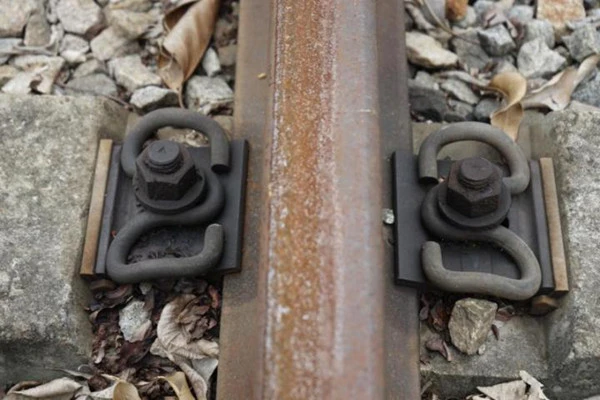
Fasteners generally refer to the connection between two parts. The track fastener refers to the connecting part between the rail and the sleeper. To put it bluntly, it is the guy who buckles the rail to the sleeper and fixes it. Here we are talking about fasteners. The main role of - fixation, constraints.
Let's take an ordinary fastener as an example to see what it does and how it works.
This is a snap type - split type - no bolt - no shoulder stop fastener. Although it looks so awkward, it is actually an ordinary fastener. Now let's dissect this fastener to see what it is.
Fasteners are constraints, which constrain the three directions of the rail, that is, up and down (vertical), left and right (horizontal), and front and rear (longitudinal), to ensure that the rail stays where it should stay.
At the same time, the subways are all electrified lines now, and they are basically DC traction systems, which have high requirements for insulation, so all the positions on the fasteners that are in contact with the rails are made of insulating materials (gauge blocks of nylon material, rubber material). under-rail gasket), which can be called insulation constraint.
In addition, the constraints of the three directions of the rail are implemented in different ways. The vertical constraints are all realized through elastic components (springs, rubber), and the lateral constraints are achieved through rigid components (relatively large stiffness, nylon, just now) Realized, the longitudinal constraint is achieved through friction (rail bottom and rubber pad, rail side and gauge block), so the horizontal constraint of the rail is large and the vertical constraint is relatively small,